Kar said that the work, which he described as “not a documentary about death, but a documentary about survival and being known,” was a beginning and that more would follow.
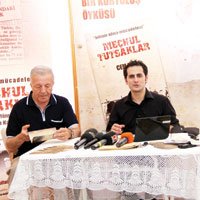
A press conference to promote the documentary film and book titled “Unknown Prisoners,” prepared by journalist and publisher Cem Kar, was held yesterday at the Foreign Press Association.
The result of research Cem Kar has been conducting since 2009, Unknown Prisoners recounts how 75 fighters from Lefke and surrounding villages, gathered after Lefke was surrendered on 22 July 1974, managed to escape. It also tells the stories of Turkish journalists who came to the island to inform the world about the second military operation, were taken prisoner, and encountered the fighters during their captivity. Journalists Ertürk Yöndem, Ziya Ergun, Mete Akyol, Yücel Hacaloğlu, Hüdai Bayık, Ahmet Kahraman, Teoman Fehim, Hami Sami Coşar, Sermet İpekçioğlu, and Eyüp Sabri Kapıdağ were taken prisoner on 17 August 1974 and, like the fighters who had been captured earlier, were taken to the Limassol Police Department. During their captivity, the journalists met the fighters and obtained their lists of names; after their release, they publicized the fighters’ names around the world, helping secure their release.
A SPECIAL SECTION: The book also includes a special section on Adem Yavuz, Turkey’s first and only press martyr in the Cyprus war, who was captured during the Cyprus Peace Operation, blindfolded, and killed. Speaking at the press conference, Cem Kar, producer and director of the Unknown Prisoners documentary, said he had contacted the journalists and fighters concerned for the film and book, interviewed those who were still alive, and obtained many historical documents. Kar said he had also tracked down Takis Çakaris, the commander of the Greek Cypriot National Guard at the time and Makarios’s personal bodyguard, who had taken the journalists to Limassol and saved their lives, and interviewed him. Kar said Çakarıs might also attend the gala tomorrow evening. He said he had interviewed 57 people for the documentary and that the accounts had been reenacted with a cast of 40, with filming taking place in various locations in Turkey and Cyprus. Kar also said the work, which he described as “not a documentary about death, but a documentary about survival and being known,” was a beginning and that more would follow. He said the documentary’s premiere would take place this evening at 19:00 at YDÜ, and that the screening would bring certain points to light. Ertürk Yöndem and Hüdai Bayık, two of the Turkish journalists taken prisoner 37 years ago, were also present at the press conference.
PRAISE FOR CEM KAR: Journalist Ertürk Yöndem congratulated Cem Kar on his courage and said, “I understand the message you are conveying to a country and a society by citing us as your source.” Yöndem said that, because of his captivity, he experienced great trembling and anxiety whenever he came to the island and the plane touched down on the runway. He said he had never forgotten the cruelty inflicted on them. Yöndem also called on state officials to seek an accounting for their capture in a manner unworthy of humanity and for the cruelty inflicted on them. Hüdai Bayık said those had been very difficult days both for them and for Cyprus, adding that Turkish Cypriots would not have been freed from the oppression of the Greek Cypriot army if the Turkish army had not landed on the island. Hüdai Bayık added that everyone needed to understand that Greek Cypriots still harbored great hostility toward Turks.