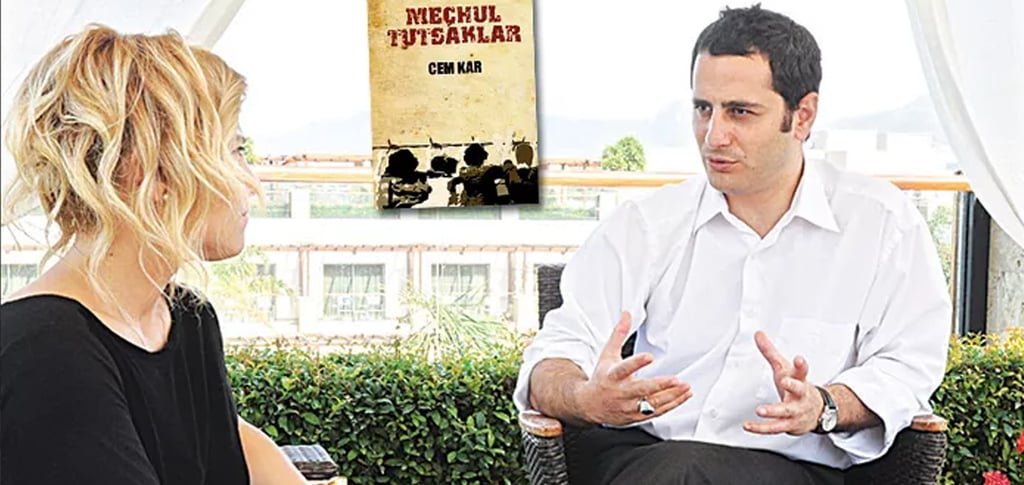
Cem Kar, who shed light on the events of 1974 with his film and book Meçhul Tutsaklar, answered our questions. Kar, who went to North Cyprus to study, also succeeded in getting people there to read. With the documentary film "Meçhul Tutsaklar," which he directed, he held up a mirror to a period in the island's history. Kar, who recounts in the former prisoners' own words what 75 fighters experienced after being captured by Greek Cypriots during the Cyprus Peace Operation, says, "Their shared anguish is having to remain alone, for years, in this confined space with those painful memories. It can hardly be a pleasant feeling to pass the cell where you were once tortured on your way to work every day." Kar voiced the TRNC residents' complaint, "Don't call us the Baby Homeland," and explained the reason this way: "The TRNC is 35 years old... How can it still be a baby? When are we going to grow up!" We spoke with Cem Kar about "Meçhul Tutsaklar" and the TRNC.
I COULDN'T BEAR TO LISTEN
The fame of your documentary has spread beyond the island, and the name "Meçhul Tutsaklar" is now often heard in Turkey. Let's start our conversation with a brief introduction to your documentary and book, if you like. Peace Operation began with the surrender of Lefke on July 22. They took 75 people from the command ranks of the fighters in the area to a place no one knew. In wartime, that meant, "You are dead." Indeed, their families held memorial services, thinking they had been killed. In their cells, they too awaited an unknown fate. After a while, they saw that Turkish journalists were also being brought in as prisoners. Thinking the journalists would certainly be released, they gave them a list of names.
As it happened, the journalists were released following intense pressure from Turkey. This led to the trail of the 75 people, who had been presumed dead, being found. Meçhul Tutsaklar is the result of my interviews with them and the Turkish journalists... You stopped many interviews partway through. People don't want to relive those days. Your questions take them back. It is traumatic. That's why I had to stop many interviews midway; I couldn't bear it either. How have the events of those days continued to affect their lives 37 years later? They affected me deeply. Fuat Abdurrezzak, one of these fighters, works on the Greek side, near where he was captured. He says, "I see that place every day; I relive those days every day."
THE REFERENDUM UPENDED EXPECTATIONS
The TRNC is not recognized around the world. As someone who settled here, how would you describe life on the island? Very bad... You are surrounded and cannot open up to the outside world. None of your athletes can represent their country. For example, Melis is a Cypriot athlete, but she competes on behalf of the Motherland. There is the concept of Motherland and Baby Homeland. Do you also think the TRNC is a "child" that will never grow up? We need to move away from this concept now. The TRNC is a state, and Turkey is a state; relations should be on that level. Christofias once told then-President Talat, "Come back when you've been weaned." We are no longer 'babies.' In short, we want to grow up... What do you think about the Annan Plan? It was a much-debated plan here. I don't know whether the Annan Plan would still exist today if it had really been implemented. But under the circumstances at the time, it was a plan the Turkish side said 'yes' to and the Greek Cypriot side said 'no' to. What is your assessment of the referendum? The referendum upended the world's assumptions. People thought, "The Turks do not want a solution under any circumstances." Indeed, because of this perception, our late President came to be known as 'Mr. No.' The referendum results showed that the Turks were seen as the side seeking a solution. In reality, it was the Greek Cypriots who did not want one. The Greek Cypriot side has no problems with the EU; reaching a solution is not especially important to them. What is the TRNC's biggest problem? The TRNC's biggest problem is politics. It is not a problem with the system, but with the entrenched political structure. Our political landscape has reached a point where everyone is forced to become politicized. We have a very popular saying: "Let's have a dictatorship for three days and solve all of Cyprus's problems." A tendency to criticize has also taken hold in Cyprus. There should be criticism, but it should not reach such unreasonable extremes... Let's talk about some positive things too; I'm sure good things are happening as well. Of course good things are happening, foremost among them the development of universities. I would especially like you to write this: Cyprus is not just a place with casinos. Cyprus has such a deep-rooted history... When you come to Cyprus, let's not just make a beeline for the casino; let's get out, ask what else there is here, and explore.
THERE'S MORE THAN JUST CASINOS...
Do casinos contribute to tourism? No, they don't, because people don't leave the hotels. There are the Tomb of Prophet Ömer and the Hala Sultan Tomb here. We have a peninsula like Karpaz, with beaches you won't find in many places around the world: they have white sand and are incredibly beautiful. Finally, there is a perception in Turkey that 'Cypriots don't like us.' Is that true? Absolutely not. Not all five fingers are the same; there may be people who don't like us. But it is wrong to attribute that to the whole population. For example, I'm from Turkey and I'm very well liked here; there are many like me. How happy for you...