Gözde AKBEN
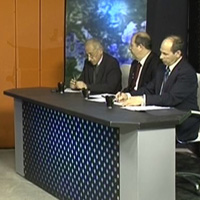
The “Difference of Opinion” program, broadcast on Ada TV and moderated by Nazar Erişkin and Cem Kar, hosted prominent guests. In the program, which was also attended by Finance Minister Ersin Tatar, economist Ünal Akifler and Kamu-Sen President Mehmet Özkardaş examined the country’s economy. Referring to lower prices in the South, Özkardaş said that falling prices in an economy were linked to competitiveness. He said that bringing prices under control and making them low enough to encourage consumers could be achieved by eliminating monopolies.
ECONOMY AND MISMANAGEMENT Emphasizing that the source of the problems facing the country’s economy lay in the accumulated effects of previous years, Akifler said, “Our economy has entered a vicious cycle that is impossible to escape. There are, of course, various reasons for this, but I believe the main one is mismanagement. The second is isolation.” Noting that by mismanagement he did not mean only the administration of the TRNC, Akifler said, “In earlier periods, Turkey’s lack of a sound understanding of Cyprus’s economy also exacerbated the problems. The measures or economic policies implemented in Turkey were often held up to us as examples and we were asked to adopt them, which also affected us negatively.” Saying that they had faced various restrictions over the years in relation to economic developments, Akifler said, “For many years, we struggled to get the restrictions lifted. The economy was closed. The same situation continued in Turkey until Turgut Özal came to power. As a result, these issues accumulated, and the economy ended up in this state.” Akifler said they had been working since 1976 to move to a currency more stable than the Turkish lira, adding that their efforts had also been misunderstood. Akifler said, “Money is perceived as a symbol of a country, like its flag. But money is a medium of exchange. Having a stable currency in an economy is very important. At the time, inflation in Turkey had reached 250 percent. We suffered greatly from it, because inflation is a cancer in an economy. It discourages people from saving and gets them accustomed to consumption. It makes the rich richer and the poor poorer. Inflation has many other harmful effects, and unfortunately, we had to endure it. I said that, as Turkish Cypriots, we should adopt a stable currency. I faced opposition. I really could not understand why people were so inflexible on this issue.”
TATAR: WE HAVE TAKEN IMPORTANT ACTIONS Assessing the country’s economic situation, Finance Minister Ersin Tatar said, “The infrastructure of an economy is of the utmost importance, and great strides have been made in this area.” Tatar said, “Before 1974, we had no resources at all. We were living in a nomadic economy. But subsequent investments made it possible to build an economy on its own land, with its own people and on its own foundations for the state of the Turkish Republic of Northern Cyprus.” Tatar said that mismanagement was the economy’s main problem, adding that the growth of the public sector had created a disadvantage for the economy. Noting that private enterprise could provide far more opportunities and investment in an economy, Tatar said, “Since taking office with the right vision—that is, a liberal outlook—our government has taken important actions.” Saying that the National Unity Party was a party that founded the republic, Tatar said, “The UBP has demonstrated the political will to make its ties and cooperation with Turkey yield opportunities for infrastructure investment, and this is extremely important. If a party other than the National Unity Party had been in power in those years, relations with our motherland, Turkey, would not have developed, and completing the development of the infrastructure here would also have been extremely difficult.” Tatar said that instead of diminishing over the years, the state’s weight in the economy had increased further, adding that they had therefore seen structural problems grow over the past four to five years. Saying that the National Unity Party had put a stop to this trend, Tatar said, “In 2010, for the first time, we saw these expenditures consolidated in the budget.” He also stressed that their main expectation going forward was increased investment, saying, “If this happens, we will see the economy grow further. This will allow greater prosperity to be distributed among sectors. That is why I am not without hope, and I do not want to be pessimistic.”
“PUBLIC-SECTOR REFORM CANNOT BE ACHIEVED” Mehmet Özkardaş said, “The global economic crisis has had an impact on the situation our country is in today in economic terms. But there are two issues that are even more important. The first is the problems arising from the lack of a settlement—that is, the isolation imposed on us. The second is our own structural deficiencies. I need not explain how greatly isolation has affected our tourism and exports. But there are also structural deficiencies of our own, namely mismanagement and partisanship.” Turning to the issue of partisanship, Özkardaş said, “At election time, whoever waves the most flags gets hired and included on the lists of names. When the government changes, party officials get together and say, ‘This person isn’t from our party,’ and people hired one night are dismissed the next. This is where our country has ended up. I ask you: how will you reform the public sector? How will you develop democracy by making partisan hires like this and taking control of people’s political will—even that of their families? How can any of this be achieved as long as this partisanship continues? You look at government offices and find some people working as laborers who are delegates of the party in power. How, in your opinion, can the supervisor, director, or minister in that department make them obey?” Özkardaş said that ending partisanship and preventing discrimination were necessary for public-sector reform, and stressed that otherwise failures in the economy and many areas of life would continue.
SHOPPING IN THE SOUTH Özkardaş also discussed the reason for the increase in shopping trips to the South. “If you pay attention, supermarket prices have kept falling because the euro has fallen,” he said. Noting that falling prices in an economy were linked to competitiveness, Özkardaş said that bringing prices under control and making them low enough to encourage consumers could be achieved by eliminating monopolies. He added that smart investment could be achieved by meeting demand in the domestic market while also opening up to alternative markets.