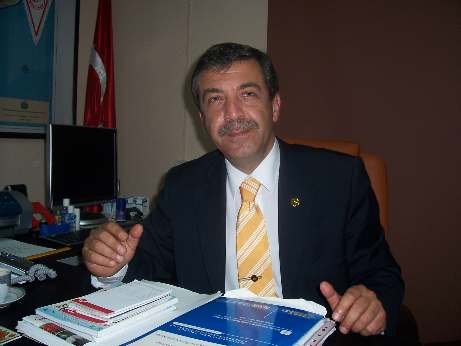
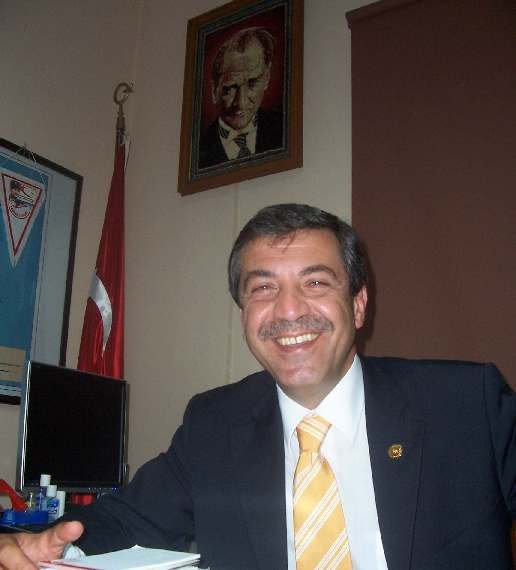
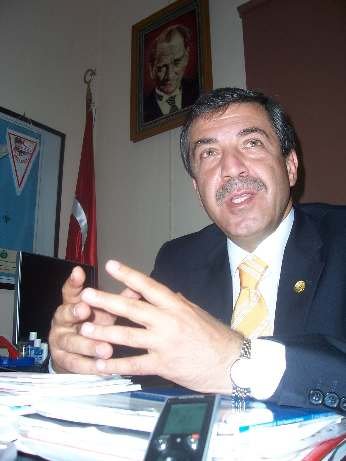
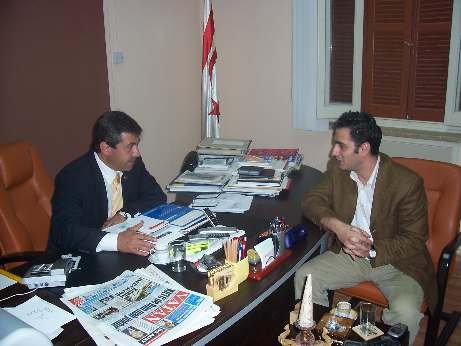
This week, my guest in the “Once Upon a Time” series will be UBP Chairman Tahsin Ertuğruloğlu. I asked Mr. Ertuğruloğlu for an interview because I believe you will be interested in the views—and, in other words, the different sides—of people we are used to seeing in the political arena when it comes to topics outside politics… In our very cheerful conversation, you will discover different sides of Mr. Chairman and his perspective on cinema.
I always have the same question in mind for these interviews: “What did the people I interview do ‘back in the day’ in movie theaters, and what was the first film they saw?” In today’s interview, as well as finding the answers to those questions, you will also learn—as I just mentioned—what people who are constantly involved in politics do outside of it.
Without further ado, let’s move on to the interview.
Cem KAR: Mr. Ertuğruloğlu, the first question I want to ask you is: “What was the first film you saw, where did you see it, and do you remember when?”
(After this question, Mr. Tahsin thinks for quite a while…)
Tahsin Ertuğruloğlu: It was before 1963, and I think I saw it in Lefke. My late father worked for the telecommunications department—which was known as SİTA at the time—and he was transferred to Lefke for a while. We stayed there on vacation for a time, too, and I think I saw my first film during that vacation. I don’t remember the film’s name, but it was most likely a Turkish film. The only thing I remember about it now is a chase scene: the person playing the villain (“Was it Erol Taş?” I ask, and we laugh…) was running away, and some people were chasing him to catch him. The villain comes to a fork in the road; he can go either right or left… Meanwhile, I get so caught up in the film that I stand up and shout, “To the right, to the right!”
C.K.: Well, you were quite helpful…
T.E.: I really got carried away…
(We laugh heartily for a long time again.)
C.K.: Politicians generally don’t have much time, but I can’t help asking. How interested are you in cinema?
T.E.: I was most involved with cinema during my student years.
C.K.: Where did you study?
T.E.: I studied at the University of Arizona. Later, I spent a year in Minnesota for a course, between 1995 and 1996. During both my studies and the course, we used to go to the cinema two or three days a week. As you know, the cinemas there were very advanced in those years. Besides, cinema is part of life in the United States; Americans are a people who love cinema! In the TRNC, on the other hand, we went through a very long period without cinemas, and unfortunately, compared with the past, that diminished the passion for cinema and the habit of going to the movies…
C.K.: Since we’ve brought it up, an issue that cinemas are grappling with today could take us back to those years; the TRNC could once again have days without cinemas. The lack of a copyright law is causing serious problems. What do you think about this issue? And if you are in government in the future, what do you plan to do about it?
T.E.: Failing to respect copyright is a kind of theft; it’s fraud. It means you are stealing someone’s work and not giving them what they are owed for it. As a political party like ours, which cares about the state, its seriousness and its standing, and which is committed to these principles and considers the institutionalization of the state in all our political approaches, we will fulfill our responsibilities to put an end to these kinds of distortions. This applies not only to cinema, but to other art forms as well. And it is a worldwide problem…
C.K.: There’s this casual attitude: “We’re a pirate state; we can do whatever we want,” and so on!
T.E.: We don’t look at our state that way, but there are people who do! That’s the excuse, after all! Whether a state is recognized or unrecognized cannot be an excuse. So, as with everything, what matters is the intention! As I said just now, we absolutely do not regard the TRNC as a pirate state. On the contrary, we argue that the TRNC is a much more legitimate state than the Greek Cypriot state in the south of Cyprus. The reason is that the Greek Cypriot state in the south claims to represent a people it does not represent. We, on the other hand, are the state of a people we genuinely represent. We do not claim to represent the Greek people!
C.K.: Do you have a cinema-related memory you’d like to share with us?
T.E.: I have a memory related to television rather than movie theaters: On the joint channel RIK, which dates back to 1960, Turkish-language films were broadcast on Friday nights. They continued to be shown even after the events of 1963! At the time, we were one of the few families in our neighborhood with a television at home. So on Friday evenings, our house would practically turn into a little movie theater… All the neighbors, children and adults alike, would gather to watch those Turkish films.
C.K.: Your home must really have been a movie theater.
(We laugh…)
T.E.: I remember going with my whole family to open-air cinemas when I was a child. There were the Şahin and Taksim cinemas, which we used to go to. I couldn’t recall any particularly special memory, but I remember going to see “Love Story.” We watched that film in a cinema on the Greek Cypriot side. We went as quite a large group of Turkish Cypriots. As you know, it’s a very sad film, and by the end, there wasn’t a single Greek Cypriot or Turk in the theater who wasn’t crying!
C.K.: The United States is the heart of cinema, and you studied there. Did you go on any cinema-related trips?
T.E.: I did my university studies in Tucson, Arizona. The old city of Tucson is where cowboy films were shot. I have a particular interest in cowboy films and war films—World War I and World War II. I went to the old city of Tucson to see the studios where those cowboy films were shot. In fact, a film was being made while I was visiting.
C.K.: Did you act in it?
(We laugh…)
T.E.: I wasn’t on camera, of course; but cowboy films get boring after a certain age! It wouldn’t even cross my mind to watch a cowboy film now.
C.K.: You have a busy schedule! Amid all that, do you manage to make time to watch films, either in cinemas or at home on television?
T.E.: Of course, I get home late. But I try to shake off the day’s fatigue by sitting in front of the television and watching whatever film happens to be on. Other than that, I don’t have the chance to sit down and watch a film from beginning to end!
C.K.: Of course, politics takes up a lot of your time. As far as I know, you’re also constantly among the people, and you consider that important!
T.E.: Anything else would be behavior I couldn’t accept. Citizens should always be able to meet with their politicians, especially outside election time! During elections, it’s already very easy to meet with everyone.
C.K.: So, what does Tahsin Ertuğruloğlu do when he makes time for himself? What does he get up to?
T.E.: One of my personal interests is football!
C.K.: Oh, yes… By the way, commiserations. —The day before this interview, Fenerbahçe had been knocked out of the cup. Of course, as a Galatasaray supporter, offering condolences is a great obligation and duty…— (We laugh for quite a while…)
T.E.: Thank you. Yes, football and Fenerbahçe are things I’m very interested in. In Cyprus, I support Yenicami as well. I played football for Yenicami years ago and served as its chairman for a year. Since becoming party chairman, I’ve made a special effort to watch Fenerbahçe matches! If I don’t have a very important engagement, I watch the matches on television, and whenever I get the chance, I go to Şükrü Saraçoğlu.
C.K.: Have you ever gone to the stadium wearing a jersey or anything like that?
T.E.: Yes, once I went to a match wearing jeans, a jersey, and a cap. It was a lot of fun. Anyway, alongside my passion for football, if I don’t have party work to do, I set Sundays aside for my wife and daughters; I make an effort to do that.
C.K.: Does the Ertuğruloğlu household enjoy a Sunday barbecue?
T.E.: It’s something I’ve never done in my life… As far as I remember from my family and childhood, we didn’t do it either. In fact, there isn’t even a barbecue grill at our house in Nicosia! There’s a grill at the house in a residential complex in Kyrenia, where we go from summer to summer; a friend gave it to me as a gift. But that grill only gets used when he comes over! I don’t even know how to light it!
C.K.: Mr. Ertuğruloğlu, is there anything you’d like to say in closing?
T.E.: Cinema is, in itself, a cultural and artistic activity and a way of life. This sector has continually suffered setbacks in the lives of Turkish Cypriots; it has never been continuous. They have experienced cinema, then been left without it. They encountered cinema again, and this time it is going through a difficult period because of pirated broadcasts. The state needs to take serious measures to overcome this. The world we live in today does not tolerate a vacuum! If you leave a gap, someone will inevitably exploit it. So this is not something the state cannot overcome. With serious oversight, piracy in any sector can be prevented. The only requirement is that the political will demonstrate its seriousness on this issue. Unfortunately, it is not possible to say that the TRNC has passed this test successfully. Piracy is a problem the world faces, but in a small country like ours, today’s technology can be used to prevent it. Cinema is a very important art form… Cinema allows someone to bring before our eyes the events that perhaps we all know about but have not paid enough attention to, and it does so by shaping society and bringing social issues to the fore.
C.K.: Mr. Ertuğruloğlu, thank you very much for taking the time to speak with me despite your valuable commitments.
T.E.: Thank you. Best of luck with your work…