Gözde Akben
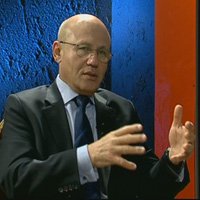
As the presidential elections approach, the country’s agenda is growing increasingly crowded. Undoubtedly, one of the busiest people amid this activity is President Mehmet Ali Talat. On the Special Agenda program, hosted by Cem Kar and featuring questions from Mehmet Davulcu, Editor-in-Chief of Star Kıbrıs Newspaper, President Talat answered the questions with complete candor.
“Progress has been made in the negotiations” Asked by Mehmet Davulcu where the negotiations stood, given that President of the Greek Cypriot Administration Dimitris Christofias had taken office and they had met 67 times since their first meeting on March 21, 2008, Mehmet Ali Talat said that progress had been made, but that further efforts were needed to reach an outcome. Talat said, “I can say that progress has been made. First of all, the Cyprus Issue was divided into six chapters. We have gone over many of them. We have not yet made any progress on property. But on that issue, too, we reached a decision on categorizing the properties. Apart from one or two minor snags, we have also reached agreement on that.” Asked what the categories were, Mehmet Ali Talat said, “We created many categories, including property belonging to legal entities, property belonging to individuals, property that has changed hands, property belonging to foundations or churches, and property used as business premises or homes. We carried out a categorization process covering all properties.” Mehmet Ali Talat said that considerable progress had also been made in the negotiations on governance and power-sharing, the economy, and the European Union. “In particular, we discussed four issues concerning governance and power-sharing,” he said. Asked what those four issues were, Mehmet Ali Talat replied, “sovereignty, foreign relations, territorial waters, and the FIR line,” adding that they had not yet reached agreement on the FIR line, but had moved closer to one another.
“Not concessions, but negotiating room” Asked about claims by some quarters that he had “made concessions” in his efforts at the negotiating table, Mehmet Ali Talat said, “I don’t use the word ‘concession.’ Making a concession means giving up a right one is entitled to. When I make proposals, I also take the negotiating room into account. This is a negotiating strategy. So I can say with a clear conscience that neither I nor Mr. Christofias has made concessions, contrary to what has been claimed.” Commenting on similar claims that Greek Cypriot leader Dimitris Christofias had made concessions, and on the fact that this had even led to the EDEK Party leaving the government, Mehmet Ali Talat said, “The main point is that, through our consistent policy, we have demonstrated that we support a solution without blaming the Greek Cypriot side. EDEK moved toward leaving the government because it opposes a solution. I think Mr. Christofias also has to be flexible. We have not taken any step that would put the Turkish Cypriots in a difficult position. In fact, we have taken positive steps through this policy. Those who accuse me will see, when they look at the south, that Mr. Christofias faces the same accusations.”
“Britain appears to support a solution” President Mehmet Ali Talat, who visited Britain last December, was asked about Britain’s position on the Cyprus issue. He said he agreed with the view that Britain bore responsibility for the emergence of the Cyprus issue. Talat said, “Britain has an approach aimed at ensuring that the negotiations continue, but it also intervenes in the process from time to time, with both positive and negative effects.” Talat said that, regarding the ruling in the Orams case, they had previously told the British government not to intervene while the negotiations were under way. “The British government appears to be one of the parties most keen on a solution. Whether that is true or not needs to be analyzed. But in general, they are taking a position in favor of a solution,” he said. Asked whether Britain feared it would lose its bases once the Cyprus issue was resolved, President Talat said, “The issue of the bases has never been discussed at the negotiating table.” President Talat said that a solution to the property issue was determined by United Nations parameters. “While the Sofi case was ongoing, the Greek Cypriot administration refused restitution. But things reached a point where the Greek Cypriot Guardianship Law could be challenged. After that, the Greek Cypriot administration began saying that it wanted a peaceful solution. This was because the Guardianship Law could have been found by the court to violate human rights. For this reason, they called for a peaceful solution. In the negotiations with the plaintiff to find a peaceful solution, they also undertook to amend the ‘Guardianship Law.’ They know very well that it is contrary to human rights. By contrast, the Immovable Property Commission we established has been accepted by the Human Rights Court,” he said.
“The issue of not having photographs taken was a provocation” Asked about claims that the press had been asked to leave during his engagements in Brussels and his meeting with the President of the European Parliament, the President said he had not experienced any such thing and described a broadcast by a media organization in the TRNC as not merely manipulation, but a provocation. President Talat said, “During our previous visits to Brussels, we had also requested a meeting with the President of the European Parliament. However, we could never find a date that worked for both sides. During my most recent visit, we had the opportunity to meet Mr. Buzek. When I arrived, he was not there yet; he was in a meeting. The members of the press were there at that time. Then the press were asked to leave. Mr. Buzek arrived while they were out, and we shook hands. The members of the press were then brought back in. We did not shake hands again. But the press took pictures while we were seated. A Turkish journalist who saw this presented it as a slight against me. People do not always shake hands in front of the press; what matters is the intention. They picked those words out of the whole report and published a picture of someone else shaking hands. This was not just manipulation; it was a provocation in itself. The reason was to try to belittle me and make me seem unimportant. At the time, supporters of the Prime Minister were praising his visit to Britain to the skies while also trying to offend me. This is both an example of manipulation and a provocation. It is an attempt to stir public outrage,” he said.
“If the Cyprus issue were resolved, the Turkish military would not be on the island” Giving his views on the resolution adopted by the European Parliament, President Talat said, “I personally went and spoke with the rapporteur who prepared the report. We had a very serious discussion. I told him that including in the European Parliament resolution matters being discussed in the negotiations amounted to interference. I said that, as a European, he should oppose deciding people’s futures based on where they came from. I said that the Turkish military was on the island not arbitrarily, but because of the Cyprus issue, and that it could leave once the issue was resolved. But Greek Cypriot members of parliament cling to people’s cases; when we are not there, they find the field open and put pressure on people.”
“If the Annan Plan had been used, a solution would have been reached long ago” Commenting on the progress of the Cyprus issue as his five-year term drew to a close, President Talat said, “If the Annan Plan had been used at the negotiating table, we would have reached a solution long ago. But the Greek Cypriot administration accepts the Annan Plan when it suits them and rejects it when it does not.” President Talat said that former Greek Cypriot leader Papadopoulos had consistently sought to prolong the process. “He brought the issues to a complete deadlock. He had urged his people to vote no in the hope of getting a better solution. But when the Greek Cypriot people began asking, ‘Well, where is that better solution?’ he found himself in a difficult position. And that is why he lost the election,” he said. Emphasizing that Dimitris Christofias had taken a more conciliatory approach than Papadopoulos, President Talat said that the Annan Plan could not be used as the basis for the negotiations with Christofias because AKEL had demonized the plan before voting “no” in the referendum.
“The Secretary-General called and thanked me” President Talat, who had begun visiting all the political parties ahead of the election period, added that there were still many organizations, institutions, and people he needed to visit. Talat said he sensed that he could get support from most of the parties he had visited so far, and that he would hold several more foreign engagements, particularly in Spain and Italy. He said he also planned to hold many more engagements at home, and did not want to make any announcement about his candidacy before completing them. Talat said that United Nations Secretary-General Ban Ki-moon had called him the day before, adding that the Secretary-General was keen for the negotiations to continue and had asked whether there was anything he could do to help the process. Talat also said that the Secretary-General had conveyed his thanks for the attention shown to him and his wife during his visit to Cyprus.
Commenting on Prime Minister Eroğlu’s engagements in Britain, President Talat said, “The visit to Britain was a timely one, because our citizens there have needs. I had also arranged my visit for that reason, so that I could meet with our citizens.” Talat stressed that what mattered was maintaining consistent engagement and a consistent political policy on the international stage going forward, and highlighted the importance of showing the world the Turkish Cypriots’ peaceful side. President Talat said he had made efforts to show the world the Turkish Cypriots’ peaceful, solution-oriented side, while Prime Minister Eroğlu had shown more of the Turkish Cypriots’ defiant, rejectionist side. President Talat said that he had pursued a positive and harmonious policy with the Turkish government to date. “Turkey is the only country that supports and recognizes us. Therefore, if we cannot work in harmony with the Turkish government, we as the Turkish Cypriot community will cease to exist,” he said. President Talat said that working in harmony with Turkey was necessary, whether willingly or out of necessity, and emphasized that he had maintained this harmony voluntarily.
“I am hopeful about a solution in 2010” Asked when he would announce his candidacy for the presidency, whether he foresaw a solution during the next five-year term if elected, and whether he would seek office again after his second five-year term, President Talat said, “You’re asking me to look a long way ahead. But my expectation is that there will be a solution by the end of 2010. Everything comes to an end. So a solution must now be reached as soon as possible. Everyone is becoming very impatient. I had said there would be a solution by the end of 2009, but that did not happen. I am hopeful about 2010.” Asked whether he would want to run again at the end of his second term, he said, “Ten years is a very long time. It is certainly not short. It is difficult to say anything now, but I will probably say, ‘That’s enough.’”
Asked what he thought of Prime Minister Derviş Eroğlu criticizing President Mehmet Ali Talat’s visit to the Karpaz region and describing it as an election campaign, President Talat said, “There was flooding in the Güzelyurt region, so I put on my rubber boots and went there. I tried to give our people some encouragement. There is also a problem in the Karpaz region at the moment. Our people invited me to come as president. I went in the course of my duties. They thought it was an election campaign, but that was not the purpose.” Giving his views on citizens who had been laid off, President Talat said, “When citizens who have worked there for many years are dismissed, they must also be offered an option that will allow them to carry on with their lives.”
“I have no opinion on the Erdoğan-Ertuğruloğlu meeting” Asked to comment on Prime Minister Derviş Eroğlu’s statement that, if elected president, he would draw on his experience in economic matters, unlike other presidents, Talat said that, as president, he too had sometimes supported the government on economic issues, but that the government also had to be willing to accept that support. Talat said that the Prime Minister was implementing a number of economic solutions, but that it was debatable how appropriate they were, and that he did not want to comment further on the matter. “But we should not mislead people either: the president’s primary role is not to directly steer the economy,” Talat said, concluding his remarks on the subject. Asked whether any message had been intended for the public through the meeting between UBP MP Tahsin Ertuğruloğlu and Turkish Republic Prime Minister Recep Tayyip Erdoğan, and the photographs that were published, at around the time and on the day Prime Minister and UBP leader Derviş Eroğlu’s presidential candidacy was announced in Nicosia, President Talat said he had no opinion on the matter. Talat said he also had no information on which to base a comment, adding that he might ask the people involved if he had the opportunity later.
President Talat said that hope for the future of the Turkish Cypriot people must be preserved. “We must continue with our current policy, because it is the policy that will lead us to safety. We have paid the price for all this time, but if there is no solution now, the Greek Cypriot side will have to pay the price. I am not saying this out of a desire for revenge. But if there is no agreement, the Greek Cypriot side will have to pay the price. That is what we are working for,” he said.