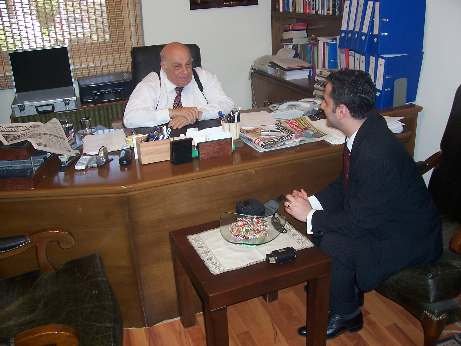
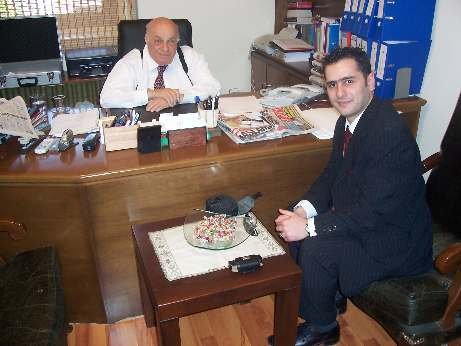
This week, I am bringing you an interview that I had been planning for a very long time and finally found the opportunity to do during the week—an interview that means a great deal to me. I have always wanted to interview Mr. Denktaş about something other than politics. It was a very pleasant and enjoyable interview for me; I hope you enjoy reading it as much as I did. I would like to thank our President once again for the interest he showed in me. Without keeping you any longer, I’ll move on to the interview…
Mr. President, first of all, thank you for taking the time to speak with me. I’m very curious: what was the first film you saw?
When we were in high school, there were the “Macit Palas” and “Papadopulos” cinemas on the Greek side. Cowboy films were popular then. We went to cowboy films every week without fail, and they came in series. At that age, when we left the cinema, some of our friends would take on the role of cowboys and head home behaving and talking like them.
What went on in the cinemas in those years, and what place do you think cinema has in the Turkish Cypriot community?
On the Turkish side, there was Necati Özkan’s “Mısırlızade” cinema. Especially in the summer months, people would fill the open-air cinema in the Çağlayan area. Of course, there was no other entertainment, either. One of the films that affected us was “The Conquest of Istanbul,” for example. The cinema was packed; people even fought their way inside. It was a major event to watch that film there and see people moved, excited, crying, shouting and applauding, and so on.
What I heard from my grandfather was that, before our time, shadow plays used to be performed in what is now Atatürk Square, before there was a cinema. Later, an open-air cinema was set up in the same square. Of course, there were silent films in those days. My grandfather would go and see those silent films; I suppose everyone watched them while imagining the story for themselves. I don’t know exactly whether there were subtitles, but even if there were, not everyone could read and write. My grandfather would come home with things he had bought at the cinema, and his wife—my grandmother—would attack him, saying, “Have you spent money at the cinema again?”
Especially after Turkish films began arriving, and after everyone started buying radios and listening to Ankara Radio, ties with Turkey grew stronger, and people’s way of speaking gradually began to change.
So the films made a significant contribution in that respect too, didn’t they?
Yes, proper Turkish took the place of the old Cypriot dialect.
Do you remember any particular incident connected with the cinema?
Let me tell you a very personal story;
My wife is my uncle’s granddaughter. When she was born, she was placed in my arms. When she was 8 or 9, she was crazy about the cinema, and the whole family would go. When we were engaged, I would often take her to the cinema. Later, she would joke with me, saying, “I thought you’d take me to the cinema often throughout our marriage. That’s why I married you.” We would eagerly look forward to being together in the cinema and spending that enjoyable hour and a half together. We’d look forward to the week passing so we could go to the cinema again. During the years I stayed in Turkey, from 1963–1968, going to the cinema in Ankara once or twice a week was our only entertainment. We saw some lovely films. But going to the cinema every week without fail had become a necessity, like food.
Of course, television has now largely taken the place of cinema, but busy people like us can’t manage to watch a film properly from beginning to end.
What was the last film you went to see?
It’s been years… I don’t remember.
On television, too, whenever I find the time, I try to follow a film—sometimes starting halfway through, sometimes missing the ending. Despite everything, films are relaxing and put you in a different frame of mind. That’s why I think cinemas need to continue: they are a social activity beyond sitting in front of the television at home. They bring something new; they are a source of pleasure.
There has been debate about “Kurtlar Vadisi.” What is your view?
I’m astonished by this! The films coming from America contain five times more violence than what is shown in “Kurtlar Vadisi.” If violence is the issue, then all those films coming in should be banned. I see an imbalance in this approach. In addition to all this, cinema, as an educational art form, has a major impact. Films about the Battle of Çanakkale and the national struggle genuinely excite and educate people. That’s why I think it deserves great importance. There are many films that could be made to teach young people about the War of Independence and the struggle in Cyprus, and how a homeland is won and liberated. Atatürk’s Nutuk is a complete script from beginning to end. Just think of everything in it! We need to give importance to television and cinema to teach these things to people who need to learn. And it’s not only those subjects: television and cinema should be used for education; they can be used for agriculture, livestock farming, fruit growing, development, the environment, and so on—provided that work is made which people will enjoy watching.
I don’t really want to get into politics, but if we had done all this properly—if we had used cinema to tell our young people about the years of the national struggle—what would their attitude toward the “Annan Plan” have been?
As for the Annan Plan, people needed to know the past well in order to vote on it knowingly. If young people had known very well what had been done to us in the past, a political party could not have deceived them. Our young people could not have been misled by claims such as, “These events were carried out by fascists,” or “They were the result of what the fascists on both sides did.” If films had been made telling the story of how these were the ideals of the Greek Cypriots and Greeks, dating back to the 1820s, how they had been striving to take Cyprus, and how the final stage was an attack on us, then naturally people—especially young people—would not have been so easily deceived, and the outcome would have been different. But the biggest factor behind the “yes” vote on the Annan Plan was pressure from the Turkish government, which said, “Vote yes; if you vote no, you will harm Turkey, and Turkey will no longer stand by you,” as well as promises made to Turkey by the US and the EU: “If you vote yes, you will enter paradise.”
What do you think of the cinema culture of the Turkish Cypriot community?
It is a deeply rooted culture. Going to the cinema with the family every week was a social activity. Especially when Turkish films began arriving, they created a completely different atmosphere for us. For example, we stopped going to cinemas on the Greek side. People would go wherever a Turkish film was showing. Cinema had a great influence on helping us get to know Turkey and speak our language more correctly. I don’t know exactly what the situation in cinemas is now; you need to speak to people in the cinema industry.
Sir, the biggest problem facing cinema professionals at the moment is copyright law. The failure to prevent pirated broadcasts is taking us back to 1982.
It is a great disgrace that there is no copyright law. There needs to be one, because whether you have reached into my pocket and taken my money or stolen my work, it is the same thing, and measures must be taken against it.
Mr. President, what would you like to say on this subject in closing?
I have always stressed this point, and in the past, when I was in office and in contact with Turkish officials, I would seize any opportunity to urge them: “Have scripts written about the War of Independence and the Liberation War, make films, and show them to young people.” I still do this. In the lectures I give now, I tell young people to read Atatürk’s Nutuk, “Şu Çılgın Türkler,” and similar books. I tell them not to listen to people who call Atatürk an atheist, and that they should read books about Atatürk’s devotion to the pure religion of the Quran. I also urge them never to listen to those who say secularism means irreligion.
Mr. President, thank you very much for your time and interest.
It is very good and important that you are researching this subject! Keep going…