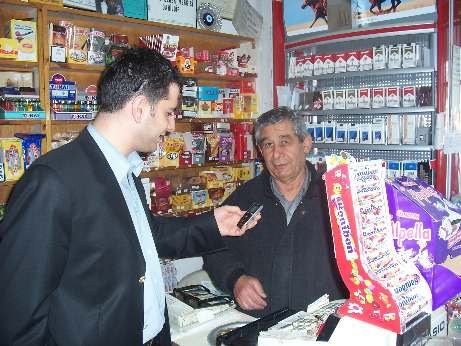
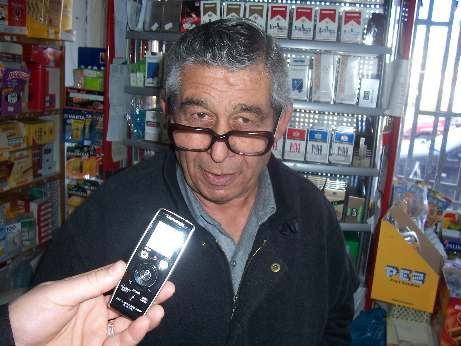
If you remember, last week I published, right here on this page in the “Once Upon a Time” column, my interview with Mr. Hasan Yaman about cinema. In our conversations, Mr. Hasan Yaman told me about someone who currently runs a grocery store but was involved in cinema in the past. I got the address and went to see him. Yes, he runs a grocery store now; but in the past—in 1956—he entered the cinema business and spent many years working in the industry. His name was Orhan Nadiroğlu. He shared some very special experiences with me…
First, could you tell me about yourself?
Orhan Nadiroğlu
What do you do now?
I run a grocery store.
What did you do before?
My profession is cinema. I closed the movie theater in 1982 because of videos. In 1983, I started working in the video-cassette business.
When did you start working in cinema?
In 1956.
What was it like working in cinema back then, and how did you get into it?
First of all, working in cinema is a good and enjoyable profession. Since there was nowhere else to go for entertainment in our country at the time, our movie theaters did good business. In 1956, we opened a summer movie theater called “Lozan Palas” in Famagusta, and in 1968 we covered the open-air theater. That same year, we built another summer theater next to it!
Were there other events at the theaters?
There were plays, concerts, and events of that kind. The Kenterler Theatre, Erol Büyükburç, Mustafa Sağyaşar, Cem Karaca, and Barış Manço are the first names that come to mind. They all came to our theater, performed plays, and gave concerts.
How did people respond when they came?
The theaters were packed. People watched them piled on top of one another!
How interested was the public in the films, and how did they respond to them?
There were films like “The Star of Şiman” and historical films, for example. They were very good films, and besides rousing the public, they were a great source of morale.
There was also a shortage of films at the time. At first, we showed dubbed films. There were Arabic films and so on. We began showing Turkish-language films with the movie “Namık Kemal,” which Nukidu Cinema brought in (they used to bring in foreign films back then). Whenever we screened it, the theater was packed. After that, an Armenian man started bringing in films; he brought some very good ones at the time. Then the “ese” film company was established, and it began bringing in films. The paint sellers brought in films.
Were only Turks and Armenians involved in this business at the time?
The Armenians started in cinema, and one of them was the main technician, too. All our machines were made in Italy; the brand was “sinemakineka.” It was the most widely used brand in the world, too. Whenever there was a problem, we would call him and he would come straight away and repair it for us.
Artists came to the theater where you worked. Who did you bring? Was it difficult during those years of struggle?
I brought Alpay. There was an investment slip for each person at the Turkish airport, and we paid the money according to that. When they left the country, we got our money back. We paid one Cyprus pound per person. I don’t remember exactly, but I think that was how it worked.
What happened at the theaters after 1963?
We became more closed off and more cautious, depending on the conditions of life. The theaters kept operating; there was nowhere else to go for entertainment! Sometimes we closed the movie theaters during days of fighting. Some weeks we opened on Wednesdays, and sometimes on Mondays; on the other days they were closed because of pressure from the Greek Cypriots. We also had difficulty coming to Nicosia because of that pressure. A few times we got as far as the barricade, then had to turn back without doing our work, because the deadline was 6 o’clock. After that, you couldn’t enter Nicosia; if you did, you would be stuck inside and unable to get back out.
You ran a theater. Did you have problems getting films because of the Greek Cypriots?
I didn’t bring in films myself, but there were restrictions before 1963. Films were censored before they reached us. We would put them into circulation after they had been censored.
What kind of censorship? For example, would they cut parts of the film?
They would cut parts; naturally, they had certain criteria. Sometimes they would watch only part of it and say it was fine.
And after 1963?
After 1963, we didn’t have very serious problems. At customs, they weighed the films and calculated their area, and we paid accordingly and collected them. Of course, the films were also censored by our side; there were categories. The films were viewed and sorted into categories, with the letters A, X, and U written on them. We would write the relevant category on the posters. Children under 16 couldn’t attend A-category films (though they could come with a parent or guardian); only those over 18 could attend X-category films; and anyone over three could attend U-category films. Cinema is a culture; it is regulated. Back then, both the police and the Child Protection Institution carried out inspections, to make sure children weren’t out wandering around at midnight, and so on. There were strict inspections at the time. Now, everything is allowed.
Did pressure from the Greek Cypriots prevent people from going into movie theaters?
I don’t know. Of course, I don’t think cinema would have grown in mixed areas outside the closed-off zones, because there were no theaters in small places. There were theaters in Mehmetçik, Gönendere, and Serdarlı (which were Turkish villages), as well as in the towns.
Do you have a memory that has stayed with you?
One evening, the projectionist arrived late. The audience had already come inside, and while I was wondering what to do (I had been watching the projectionist beforehand, seeing how he worked and how the film ran through the machine), I went up to the projector and started the film. I managed it… From that day on, all the film work was under my control: checking the films, loading them, taking them out, and rewinding them. In short, the projectionist’s late arrival helped me a lot. I was curious, and thanks to that curiosity, I became very good at it.
Let’s go back to 1982. You said you closed the theater that year. All the other theaters closed along with yours. What was the problem?
We were all losing money. Video had made its way into coffeehouses, and the cassettes were pirated anyway at the time. The cassettes arrived before the films were released! We complained to the government and the administration in power at the time; we went in person as cinema operators, but unfortunately we couldn’t stop the flood of pirated videos.
So, like the DVD situation now; people in the cinema business are complaining about the same thing today.
Absolutely. If there’s no copyright protection in a country, you can’t do business there. You can’t do any kind of business. If a copyright law isn’t passed, operators will suffer losses. We’ll return to the situation we had in 1982. A producer’s work isn’t protected. And things that aren’t protected end up in the hands of thieves. In my opinion, trading in something without paying for it is theft. That’s why a copyright law needs to be passed.
Finally, what would you like to say?
Thank you for your interest.
Thank you.