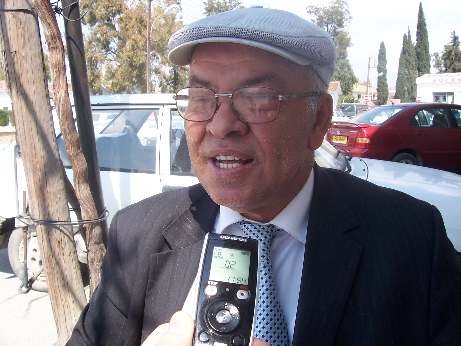
On a weekday, I stopped by a coffeehouse near the Presidential Palace, one I often visit too. I ran into Mr. Hasan Yaman there, and I asked the questions while he answered. It was a very long interview, just as I had expected: before the TRNC was established, during the years of struggle, cinema halls were hugely important.
Now I’m sharing the interview I did with Hasan Yaman on a weekday, believing it will interest you…
First, may I ask who you are?
My name is Hasan Yaman…
The cinema culture of the Turkish Cypriot community in the 1960s and 1970s, what happened in the cinemas, your memories—it’s a very broad subject. What was it like?
Cinema is a matter of culture. But Cypriot society also has a pre-1960 period. During the times when Greek Cypriots and Turkish Cypriots lived side by side, they could go to the same cinemas. In the Karpaz region where I lived, cinemas were mostly in Greek Cypriot villages, and special Turkish-language films were brought in. I was a child then, and there were actors like Suzan Yakar in the films. After watching them, people could see how closely this place was tied to Turkey. Even a Turkish flag had an enormous effect on Cypriot society. It was a great source of motivation. The artist I remember from those films with Turkish songs—which I went to see a few times with my older sisters, even though I was in primary school then—is Suzan Yakar.
After 1963, when the events broke out, Turkish cinemas came to the fore. They mostly showed films starring Turhan Seyfioğlu, Belgin Doruk, and Ayhan Işık. For example, I remember Şiman Yıldızı. In Şiman Yıldızı, when the flag appears, the applause starts, because the appearance of that flag and the actions of the Turk there were already in keeping with the situation here. At that time, you would look for a flag and couldn’t find one, so you’d go to a tailor, who would sew a crescent and star onto a piece of red cloth himself. They may not have been the same quality as the flags we have now, but tailors would sew them…
So flags were very hard to find, and seeing one in a film was a source of morale for people, wasn’t it?
Of course, it lifted people’s morale and motivated them. For example, when the events of 1963 began, I immediately went to Namık Kemal High School, because I was on my own and our home was in the Greek Cypriot area. They immediately put a pistol in my hand there and said, “You’re on guard duty tonight.” It was the first time I’d held a pistol (I’d used an air rifle before). At night, the Greek Cypriots opened fire; of course, our older brothers were there.
Where were you on guard duty?
At Namık Kemal High School, in Famagusta. I was only in my first year. Given the situation, I went inside; there were dormitories, and I stayed there for three days. We were under the supervision of our older brothers, who directed us. I didn’t use the pistol, but they did. When the firing started, the mujahideen came and told us, “You’ve done your duty,” then sent us into Famagusta. I stayed in the city for three or four days.
Three students and a driver set off for Mehmetçik. Greek Cypriot police caught us in Çayırova, but they had no bad intentions; we were going to be released. Then, on a sudden order, we were taken to the “lockup” in Geçitkale and interrogated… It was a very cold winter night. They gave us blankets in the lockup. Meanwhile, where we were staying, I was stuffing orange peels into the gaps to block them. When we got up in the morning, the peels had dried completely; that’s how cold it was. Later, the British police and the late Hasan Güvener heard about us and got us out of there. We were among the few people who were captured and survived in that period. In other words, anyone who was captured was almost certainly killed.
Then we went to Mehmetçik, where the weapons were brought out. We cleaned them thoroughly; as it turned out, those weapons were being sent as far as Baf. Of course, we returned to Famagusta. I didn’t go to Mehmetçik at all for 11 months, and during that time I finished high school… After finishing high school, I went back to Mehmetçik. Our guard-duty shifts started again there. There was a cinema hall in Mehmetçik at the time.
We went to the cinema two nights a week. We also had a good football team, founded by Mr. Eroğlu. We played football with the UN. Besides that, I had something else to do: while I was at Namık Kemal High School, I’d learned photography. There was no electricity in Mehmetçik, so I went to the cinema owner and said, “Make me a darkroom, and I’ll do photography here.” My real aim, meanwhile, was to be able to go to the cinema even on nights when I was on guard duty. There was a lot of youthful energy in the cinema hall… I did photography, and, for example, I made negatives of pictures of Hülya Koçyiğit and Türkan Şoray that appeared in the very popular Ses magazine at the time, printed copies from the negatives, and handed them out to my friends…
Like posters?
Yes, like posters. Of course, back then people were either Hülya Koçyiğit fans or Türkan Şoray fans, and they carried a picture of whichever one they liked. The pleasure of going to the cinema meant the halls were packed. At the time, one of our teachers from high school was in Mehmetçik. He said, “Let’s put on a play together.” I played the lead role. The hall had 250 seats, and we thought that if 300 people came, we could arrange the hall with chairs we gathered from here and there.
The plays were staged in cinema halls, weren’t they?
Of course, we were going to perform in the Mehmetçik cinema hall. We carried chairs from coffeehouses and from here and there, and increased the seating capacity of the 250-seat hall to 300. Can you believe it? So many people came from the surrounding villages that we performed for 600–650 people. There was no way they could all fit into the cinema. We borrowed chairs from the schools too, but naturally that wasn’t enough, and most people watched standing up. Admission was two shillings. We brought in an entirely unexpected amount of money, and used it to buy books for three poor students. Later, we wrote to the embassies in Turkey on behalf of the association, and books arrived by the bagful. We set up a library at the association.
Are those books still there?
Some of them must still be at the association.
You went to Istanbul to continue your education. Did you carry on with photography there, or with your love of cinema?
The subject I studied was difficult, of course—chemical engineering—but I always made time to photograph the places I’d seen in Turkish films, and I took a lot of photographs in Istanbul. We also went to the cinema in Istanbul…
What would you like to say in closing?
After the Cypriot people separated from the Ottoman Empire, they continued their culture; cinema is part of that culture. For example, the Turkish Cypriot Derviş Zaim goes off and makes films; because he grew up in the culture here, he was drawn to that work. The Turkish Cypriot people are a people with a high level of culture. They inherited this cultural level from the Ottomans and embarked on this struggle. That’s why, in my view, the Turkish Cypriot people have no fear! Because the blood running through their veins says this country is “my land,” and Fatih’s seal at Hala Sultan says the same thing.
Turkish cinema had a great impact on the morale and motivation of the Turkish Cypriot people between 1963 and 1974. This morale and motivation helped the Turkish Cypriot people reach where they are today. That is how great its influence on the community was.
I believe it is necessary to bring cinema back to the people. Cinema culture will definitely keep young people from going down the wrong path and guide them in other directions. It encourages them to do the good things they see there. The Ministry of National Education has the most important role to play here. Programs need to be implemented that will guide our young people toward cultural activities.
The love and respect that existed in that period when we were an isolated community need to be restored to this society.
Thank you very much, Mr. Hasan…
Thank you.